Many capitals - for example, Paris and Washington - were planned with grand linear avenues conceived in the spirit of triumphal processions. Confederation is not linear. It is inclusive. It draws a circle around the downtown areas of Ottawa (in Ontario) and Gatineau (in Quebec). It connects both sides of the Ottawa River. It responds organically to the landscape and to existing buildings.
The NCC describes Confederation Boulevard
NCC Website
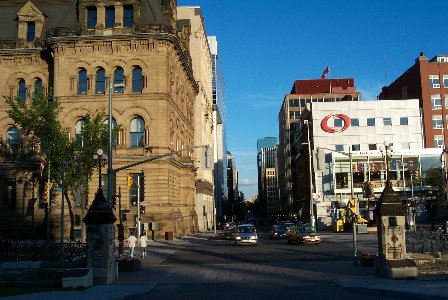
Looking south on Metcalfe, the Capital Info Centre is on the right
While the NCC now pretends to prefer "responding organically to the landscape" over aping the "grand linear avenues" of the great capitals, it's a recent conversion. Back in 1998, the NCC dropped a bombshell proposal to demolish dozens of buildings along Metcalfe Street to create just such a "Grand Boulevard". The NCC wanted to widen Metcalfe from Wellington all the way to the Museum of Nature: 17 blocks, including many historic buildings, would be expropriated and bulldozed at enormous cost. The plan, if implemented, would have also seriously eroded the City of Ottawa's commercial tax base.
In typical schizophrenic NCC style, the plan would also demolish the NCC's own Capital Info Centre, which had just been renovated at a cost of several million dollars. The plan included an expanded Info Centre in another location.
CTF: NCC Mandarins Believe Money Grows on Trees [19 Jun 1998]
Citizen: The Miracle on Metcalfe Street [9 Jun 1998]
Citizen: Boulevard of Chretien's dreams [11 Jun 1998]
Citizen letter: NCC vision: Majestic or moronic? [12 Jun 1998]
Citizen: NCC's vision for capital sadly myopic [15 Jun 1998]
Citizen: Metcalfe vista faces dead end [3 July 1998]
Citizen: NCC plan draws critics [21 Aug 1998]
Centretown News: $5 Billion Plan bad for City [25 Sep 1998]
Stop The Metcalfe Madness
Time: Ottawa's makeover [9 Nov 1998]
The storm of protest that this proposal created was memorable. Ottawa City Council quickly passed a motion against the plan, residents were against it - nobody (apart from the NCC, and, notably, Jean Chretien, Bob Chiarelli and Mac Harb) liked the idea. A "Stop the Metcalfe Nonsense" coalition of city and regional politicians, heritage experts and the Canadian Taxpayers Federation soon formed to block the plan.
It would cost millions to expropriate land and each expropriation would erode the City of Ottawa's commercial tax base. Then we add millions more for a tendering process and detailed design schematics. After all this, taxpayers would be asked to fork out billions for building demolition and new construction.
What's even worse, the NCC's record in development is less than stellar. To the west of the downtown core lies LeBreton flats, a 66-hectare tract of land that has sat undeveloped for over 30 years. And right in the heart of the city lies the Daly site which has sat empty and undeveloped for over a decade. Both of these properties, owned by the NCC, point to a great talent for thumb-twiddling and not much else when it comes to development.
Canadian Taxpayers Federation
Faced with nearly unanimous and withering criticism and, more importantly, no prospect of a budget for the plan, the NCC gradually whittled its plan down to only 4-10 blocks before finally withdrawing the proposal entirely.
Notoriously slow learners and seemingly desperate to demolish something - anything - the plan soon cropped up again though as part of the NCC's plan to "revitalize" Sparks Street. Dubbed "Metcalfe Light," this plan called for demolishing only the west side of Metcalfe from Wellington to Queen Street and putting in an underground parking lot. Of course, these blocks included some historic buildings, which the NCC intended to move (at tremendous cost). Eventually, this plan was also abandoned.
Citizen: Metcalfe grand allee dream is dead [20 Feb 1999]
Citizen: NCC floats new proposal for Sparks-Metcalfe area [10 Nov 1999]
Citizen: NCC ponders 'Metcalfe Lite' [12 Nov 1999]
Citizen: Move history out, people in: NCC plan [13 Nov 1999]
Citizen: What's the point? architects ask NCC [14 Nov 1999]
Citizen: Public must rally to kill plan, Mayor says [16 Nov 1999]
Citizen: Metcalfe plans 'just crazy' [19 Nov 1999]
Citizen: NCC's radical plans for Metcalfe [29 Dec 1999]
Of course, plans never die at the NCC, they get filed away. Chairman Beaudry has repeatedly refused to categorically rule out the original plan, to which he remains sentimentally attached:
Mr. Beaudry says in cities such as London and Paris, which so many people admire, buildings had to be torn down to make way for large boulevards. And he laments that today "it seems this is almost impossible."
Ottawa Citizen 5 May 2003
And so the NCC is now resigned to "responding organically to the landscape and to existing buildings." But the Metcalfe Grand Boulevard stands as a classic example of NCC hubris, and clearly illustrates the NCC's attitude towards Ottawa: to the NCC, the city of Ottawa is an impediment, not an asset.